

The Rise of 6 Emerging Therapies in a Critical Spinal Cord Injury Market Void | DelveInsight
The SCI treatment pipeline continues to expand, featuring candidates such as KP-100IT (Kringle Pharma), Neuro-Cells (Neuroplast), MT-3921 (Mitsubishi Tanabe Pharma America), Elezanumab (AbbVie), PMZ-1620 (Pharmazz), NFX88 (Neurofix), NVG-291 (NervGen Pharma), and others. The introduction of these innovative spinal cord injury therapies is expected to revolutionize the SCI treatment landscape in the coming years.
New York, USA, April 02, 2026 (GLOBE NEWSWIRE) -- The Rise of 6 Emerging Therapies in a Critical Spinal Cord Injury Market Void | DelveInsight
The SCI treatment pipeline continues to expand, featuring candidates such as KP-100IT (Kringle Pharma), Neuro-Cells (Neuroplast), MT-3921 (Mitsubishi Tanabe Pharma America), Elezanumab (AbbVie), PMZ-1620 (Pharmazz), NFX88 (Neurofix), NVG-291 (NervGen Pharma), and others. The introduction of these innovative spinal cord injury therapies is expected to revolutionize the SCI treatment landscape in the coming years.
The spinal cord injury treatment landscape stands at a critical juncture. Despite the devastating impact on millions of patients worldwide, with approximately 18,000 new cases reported annually in the United States alone, the therapeutic arsenal remains dangerously limited. Currently, STEMIRAC, an autologous stem cell therapy available exclusively in Japan, remains the only approved disease-modifying treatment.
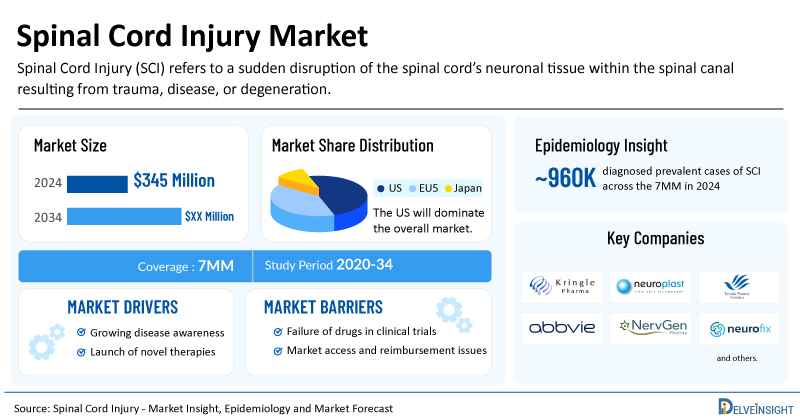
This stark reality underscores an urgent unmet medical need that is compelling pharmaceutical companies to accelerate the development of transformative therapies. The SCI market, valued at USD 354 million in 2025, is projected to expand by 2034 at a remarkable 15.4% CAGR, driven almost entirely by the introduction of emerging pipeline therapies.
Discover how big is the spinal cord injury market forecast @ https://www.delveinsight.com/sample-request/spinal-cord-injury-market?utm_source=globenewswire&utm_medium=pressrelease&utm_campaign=spr
This anticipated market expansion reflects not merely economic opportunity but a fundamental shift in how the medical community approaches SCI management, transitioning from symptomatic management to disease-modifying interventions that address the underlying pathophysiology of neuronal injury and degeneration. Below, we highlight six key SCI therapies poised to reshape the future of spinal cord injury management.
Kringle Pharma’s KP-100IT
Hepatocyte Growth Factor for Neuroprotection and Axonal Regeneration
KP-100IT is an intrathecal therapy developed by Kringle Pharma that uses hepatocyte growth factor (HGF) to treat acute spinal cord injury. The therapy aims to protect neurons and promote axonal regeneration, with the potential to enhance motor function recovery in patients. In 2019, Japan’s MHLW granted KP-100IT orphan drug designation, and in 2024, Keio University initiated a collaborative research effort to identify biomarkers associated with spontaneous recovery following SCI.
Additionally, Kringle Pharma entered into a partnership with Keio University School of Medicine in 2021 to advance the development of next-generation HGF-based treatments. In March 2024, Keio University reported gene-expression changes observed after HGF administration in acute SCI, providing further insights into its therapeutic mechanism. Subsequently, in June 2025, Kringle Pharma announced that the U.S. FDA had also granted orphan drug designation to KP-100IT for the treatment of acute-phase spinal cord injury.
Sadaf Javed, Manager of Forecasting and Analytics at DelveInsight, commented that KP-100IT is emerging as a promising therapy, with DelveInsight projecting market penetration reaching ~USD 27 million in 2034 across the 7MM.
Neuroplast’s Neuro-Cells
Bone Marrow-Derived Autologous Stem Cell Therapy for Regeneration and Immunomodulation
Neuro-Cells is an advanced autologous stem cell therapy in development for traumatic spinal cord injury (TSCI). Sourced from a patient’s own bone marrow, the therapy aims to regulate inflammatory responses and stimulate regenerative processes within the central nervous system, with the objective of maintaining and improving neurological function, mobility, and patient independence.
The European Medicines Agency (EMA) awarded Orphan Drug Designation (ODD) for traumatic SCI in May 2019. In September 2023, Neuroplast completed patient enrollment in its Phase II clinical study assessing Neuro-Cells in TSCI. Clinical findings indicate a strong safety and tolerability profile, with no treatment-related adverse events observed and favorable patient-reported outcomes. The therapy is currently progressing through Phase II/III clinical evaluation for traumatic SCI.
Sadaf further concluded that Neuroplast's Neuro-Cells emerging as the second-largest growth opportunity in the SCI pipeline from DelveInsight's perspective, with projected market penetration reaching USD 270 million in 2034 across the 7MM, substantially exceeding KP-100IT's projections despite anticipated regulatory approval later in 2034.
Explore what are key clinical trials or Phase III assets @ Emerging Therapies in Spinal Cord Injury Market
Mitsubishi Tanabe Pharma America’s MT-3921
RGMa Inhibition for Neuronal Regeneration
MT-3921 (unasnemab) is an innovative humanized monoclonal antibody targeting RGMa, jointly developed by Mitsubishi Tanabe Pharma Corporation (MTPC) and Osaka University. By inhibiting repulsive guidance molecule A, a key regulator that suppresses neuronal survival and regeneration, the therapy shows potential as a treatment for spinal cord injury. In July 2021, the US FDA awarded Fast Track Designation to MT-3921, enabling accelerated regulatory interactions to advance its development for SCI. A Phase II proof-of-concept clinical study was subsequently launched in September 2021, enrolling SCI patients across sites in the US, Japan, and other regions.
Aparna Thakur, Assistant Project Manager, Forecasting and Analytics at DelveInsight, highlighted MT-3921 as a critical-path asset in the SCI pipeline, with a projected market penetration of USD 367 million by 2034, positioning it as the second-largest single-asset opportunity in the 7MM SCI market.
AbbVie’s Elezanumab
RGMa Inhibition
Elezanumab (ABT-555), developed by AbbVie, is a human IgG1 monoclonal antibody targeting repulsive guidance molecule A (RGMa) and directly parallels MT-3921's mechanistic approach. Like its competitor, Elezanumab blocks RGMa-mediated axonal growth inhibition, facilitating neuronal regeneration and circuit reconstruction.
Both MT-3921 and Elezanumab target RGMa via monoclonal antibodies, yet subtle differences in antibody construction, binding kinetics, and Fc region engineering may influence clinical profiles, immunogenicity rates, and manufacturing efficiency. From a mechanistic perspective, both agents should demonstrate broadly similar efficacy profiles, with differentiation emerging through clinical trial performance, manufacturing scalability, and development timelines.
Elezanumab is currently undergoing evaluation in a phase II clinical trial (NCT04295538) for spinal cord injury treatment. In September 2020, AbbVie announced that the FDA granted Orphan Drug and Fast Track designations to it as an investigational therapy for patients with spinal cord injury.
According to Ramandeep, Senior Consultant, Forecasting and Analytics at DelveInsight, Elezanumab stands out as a major competitive threat to MT-3921, achieving the highest single-asset market projection in the emerging SCI pipeline, with revenues expected to reach USD 437 million in 2034.
To know more about which drugs are in late development for SCI, visit @ Spinal Cord Injury Medication
Neurofix’s NFX88
Lipid-Based Neuropathic Pain Relief Through Membrane Modification
NFX88 is a novel therapy designed to address neuropathic pain often experienced by individuals with spinal cord injuries. Composed of a unique lipid-based compound (2-hydroxyoleic acid), NFX88 works by directly interacting with cell membranes to alleviate pain. Its mechanism differs from conventional treatments by altering the molecular composition and physicochemical characteristics of these membranes.
This membrane interaction initiates a cascade of intracellular effects, reducing the production of proinflammatory molecules such as lysophosphatidic acid and phospholipase A, while enhancing the expression of factors that support neuronal repair and growth, including GDF10 and TNC.
Clinical studies have shown promising results: Phase I (NCT01792310) confirmed tolerability, and Phase IIA (2018-004792-13) demonstrated both a favorable safety profile and significant therapeutic benefit, with many patients reporting meaningful pain relief without notable side effects.
Following the successful completion of Phase IIA, Neurofix Pharma is preparing to advance NFX88 into Phase IIB/III trials later this year. This critical study will span around 30 hospitals across multiple EU countries and represents the final stage before potential commercialization, contingent on positive outcomes.
NervGen Pharma’s NVG-291
First-in-Class Neurorepair Peptide
NervGen holds exclusive worldwide rights to NVG-291, a pioneering therapeutic peptide aimed at promoting repair in the nervous system. The underlying technology is licensed from Case Western Reserve University and is based on preclinical research showing the efficacy of NVG-291-R, the rodent version of the compound, in animal models of spinal cord injury.
These studies indicate that NVG-291-R supports neurorepair and functional recovery in both the central and peripheral nervous systems following injury through multiple molecular and cellular mechanisms, including enhanced neuronal sprouting (plasticity), remyelination, and the induction of a non-inflammatory microglial phenotype. The FDA has granted Fast Track designation to NVG-291 for spinal cord injury.
In June 2025, NervGen Pharma Corp. announced positive topline results from the chronic cohort (1–10 years post-injury) of its Phase 1b/2a trial evaluating NVG-291 for spinal cord injury. The data reinforced NVG-291’s potential to facilitate nervous system repair, with the trial meeting one of its co-primary endpoints: improved motor connectivity in chronic cervical SCI participants treated with NVG-291 (n=10) versus placebo (n=10).
Patients receiving NVG-291 exhibited a three-fold increase in motor connectivity to the first dorsal interosseus muscle, measured by normalized motor evoked potential (MEP) amplitude (Baseline/Week 12: 6.207/18.773 for NVG-291 vs. 6.527/7.760 for placebo; p=0.0155). The second co-primary endpoint, evaluating leg muscle (tibialis anterior) connectivity, did not achieve statistical significance. The trial protocol considered the study successful if at least one co-primary endpoint reached significance, with a stringent p-value threshold of <0.025.
Discover more about SCI drugs in development @ Spinal Cord Injury Clinical Trials
Apart from these emerging SCI drugs, several other candidates such as Pharmazz’s PMZ-1620, ReNetX Bio’s AXER-204, NurExone’s ExoPTEN, and others are also in development. In summary, the emerging spinal cord injury therapeutic landscape represents one of the pharmaceutical industry's most compelling transformation opportunities. With STEMIRAC as the sole FDA-approved option (Japan-exclusive), emerging therapies addressing fundamentally distinct pathophysiological mechanisms position the SCI market for explosive growth from USD 354 million (2025) to USD 1.4 billion (2034).
Source: Spinal Cord Injury Market Report
Spinal Cord Injury Market Insights, Epidemiology, and Market Forecast – 2034 report delivers an in-depth understanding of the disease, historical and forecasted epidemiology, as well as the market trends, market drivers, market barriers, and key prostate cancer companies, including Nipro Corporation, Kringle Pharma, Neuroplast, Mitsubishi Tanabe Pharma America, AbbVie, BioCT, Neurofix, NervGen Pharma, Pharmazz, ReNetX Bio, NurExone, and others.
About DelveInsight
DelveInsight is a leading Business Consultant and Market Research firm focused exclusively on life sciences. It supports pharma companies by providing comprehensive end-to-end solutions to improve their performance. Get hassle-free access to all the healthcare and pharma market research reports through our subscription-based platform PharmDelve.

Contact Us

Shruti Thakur

info@delveinsight.com

+14699457679

www.delveinsight.com

Legal Disclaimer:
EIN Presswire provides this news content "as is" without warranty of any kind. We do not accept any responsibility or liability for the accuracy, content, images, videos, licenses, completeness, legality, or reliability of the information contained in this article. If you have any complaints or copyright issues related to this article, kindly contact the author above.
